
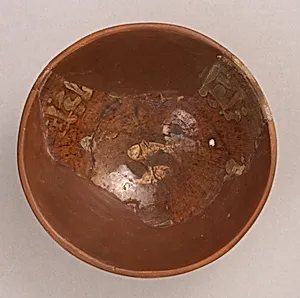
Fragment of a Bowl
Unknown Artist
14th–15th century
Medium
Earthenware; incised decoration through a white slip and coloring under transparent glaze
Dimensions
H. 3 3/16 in. (8.1 cm) Diam. 6 13/16 in. (17.3 cm) Wt. 14.2 oz. (402.6 g)
Classification
Ceramics
Department
Islamic Art
Museum
Metropolitan Museum of Art, New York, NY
Credit
Rogers Fund, 1907
Accession Number
07.238.11
Rights
Public Domain
Art Historical Context
This delicate fragment of a bowl, dating to the 14th–15th century, offers a glimpse into the refined world of Islamic ceramics from the medieval Islamic world, likely produced in regions like Persia or Central Asia. Though only a portion survives—measuring 3 3/16 inches high and 6 13/16 inches in diameter—it evokes the everyday elegance of tableware used by merchants, scholars, and elites during a golden age of cultural exchange along the Silk Road. Crafted from earthenware, the bowl features incised decoration carved through a white slip—a creamy layer applied over the clay body—revealing contrasting colors beneath, all sealed under a transparent glaze. This sgraffito technique, a hallmark of Islamic pottery, allowed artisans to create intricate patterns with remarkable precision, mimicking the luminosity of more luxurious metalwork or textiles at a fraction of the cost. The method's durability ensured these pieces graced both humble homes and grand palaces. Acquired through the Rogers Fund in 1907 and now housed in The Metropolitan Museum of Art's Islamic Art department, this fragment highlights the technical ingenuity and aesthetic sophistication of anonymous potters whose innovations influenced ceramics across Eurasia. Even in its broken state, it whispers stories of vibrant bazaars and timeless artistry.