
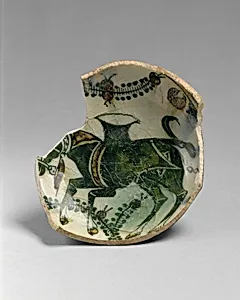
Fragment of a Bowl
Unknown Artist
12th–13th century
Medium
Stonepaste; painted on opaque white ground under transparent glaze
Dimensions
Max. H. 2 1/4 in. (5.7 cm) Max. Diam. 4 15/16 in. (12.5 cm)
Classification
Ceramics
Department
Islamic Art
Museum
Metropolitan Museum of Art, New York, NY
Credit
Rogers Fund, 1910
Accession Number
10.44.8
Rights
Public Domain
Tags
Art Historical Context
This delicate fragment of a bowl, to the 12th–13th century, hails from the vibrant world of Islamic, where artisans pushed the boundaries of pottery-making. Crafted from stonepaste—a composite of quartz, clay, and glass frit—this medium was a clever Islamic innovation to mimic the translucency of Chinese porcelain which was highly prized but unavailable locally. The surface features painting on an opaque white ground fired under a transparent glaze, creating a luminous, durable finish that protected intricate designs while allowing colors to shine through. Though only a portion survives (measuring just 2¼ inches high and nearly 5 inches across), the fragment hints at the bowl's original splendor, likely adorned with lively scenes of horses—a recurring motif in Islamic art symbolizing speed, power, and nobility. Such imagery often appeared in equestrian or hunting compositions, reflecting the cultural reverence for these noble animals in medieval Islamic societies, from Persia to Syria. Acquired through the Rogers Fund in 1910, this piece from the Metropolitan Museum of Art's Islamic Art collection showcases the technical mastery and aesthetic elegance of the era's potters, whose wares graced tables and dazzled collectors across the medieval world. A testament to enduring craftsmanship, it invites us to imagine the full vessel in its heyday.