
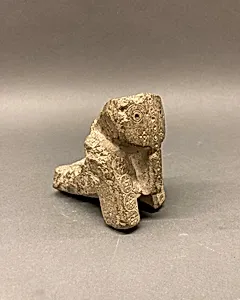
Possibly a Lamp
Unknown Artist
8th–13th century
Medium
Soapstone; carved
Dimensions
H. 1 7/16 in. (6.2 cm) W. 3 7/8 in. (9.9 cm)
Classification
Stone
Department
Islamic Art
Museum
Metropolitan Museum of Art, New York, NY
Credit
Rogers Fund, 1948
Accession Number
48.101.244
Rights
Public Domain
Art Historical Context
This delicate soapstone object, tentatively identified as a lamp, hails from the Islamic world between the 8th and 13th centuries—a golden age of artistic innovation spanning the Abbasid Caliphate and early medieval dynasties. Carved with precision, its modest dimensions (just 1 7/16 inches high and 3 7/8 inches wide) suggest it was designed for intimate, everyday use, perhaps illuminating homes, mosques, or scholarly spaces. Such artifacts reflect the ingenuity of Islamic craftsmen, who transformed utilitarian items into symbols of cultural refinement. Soapstone, a soft yet durable material prized for its workability, was a favored medium in regions like Persia and Central Asia during this era. The carving technique allowed for intricate detailing, though the exact motifs remain subtle on this piece. Lamps like this were essential in pre-electric societies, often fueled by oil and wicks, embodying the Islamic emphasis on light as a metaphor for knowledge and divine guidance, as evoked in the Quran. Acquired through the Rogers Fund in 1948 and now housed in the Metropolitan Museum of Art's Islamic Art Department, this anonymous treasure offers a window into the everyday artistry of a vibrant civilization. Visitors are invited to imagine its gentle glow casting shadows across ancient prayer rugs.