
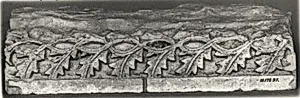
Fragment of Molding with a Leaves Pattern
Unknown Artist
6th–7th century
Medium
Limestone; carved in relief
Dimensions
H. 6 1/8 in. (15.6 cm) W. 23 3/4 in. (60.3 cm) D. 11 in. (27.9 cm)
Classification
Sculpture
Department
Islamic Art
Museum
Metropolitan Museum of Art, New York, NY
Credit
Rogers Fund, 1910
Accession Number
10.175.97
Rights
Public Domain
Art Historical Context
This delicate fragment of limestone molding, carved in low relief with a repeating pattern of stylized leaves, dates to the6th–7th and hails from the early Islamic world. Measuring just over 23 inches wide, it likely adorned the architectural elements of a mosque, palace, or public, showcasing the era's embrace of vegetal motifs as a hallmark of Islamic decoration. These lush, scrolling leaves evoke the natural abundance of gardens and paradises described in Islamic texts, serving as a non-figural alternative to human or animal imagery in sacred spaces. Crafted from durable limestone—a common medium in the region—the relief technique demonstrates masterful stone carving, where artisans incised shallow designs to create depth and shadow play under light. This piece reflects the artistic transition from late antique traditions (like Byzantine and Sasanian influences) to distinctly Islamic aesthetics, emphasizing rhythm, symmetry, and infinite repetition. Acquired through the Rogers Fund in 1910, it now graces the Metropolitan Museum of Art's Islamic Art department, offering visitors a tangible glimpse into the sophisticated ornamental world of early Muslim architecture.