
Fragment of a Plate
Unknown Artist
8th–13th century
Medium
Jet; incised
Dimensions
H. 4 1/8 in. (10.5 cm) W. 2 3/8 in. (6.1 cm) D. 1 in. (2.5 cm)
Classification
Stone
Department
Islamic Art
Museum
Metropolitan Museum of Art, New York, NY
Credit
Rogers Fund, 1948
Accession Number
48.101.255
Rights
Public Domain
Art Historical Context
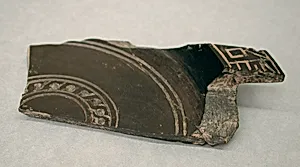
This delicate fragment of a plate, from jet—a dense, black fossilized wood prized for its lustrous polish—offers a glimpse into Islamic artistry from the 8th to 13th centuries. Measuring just over 4 inches high, this small piece (H. 4 1/8 in., W. 2 3/8 in., D. 1 in.) survives from the expansive Islamic world, where such materials were sourced for their durability and aesthetic appeal. Housed in the Metropolitan Museum of Art's Islamic department, it entered the collection via the Rogers Fund in 1948. The artwork's incised decoration—fine lines carved into the jet's surface—highlights the precision of anonymous artisans during a golden age of Islamic craftsmanship. Jet, rare for larger vessels, was often used for intimate objects like amulets or seals, suggesting this plate fragment may have served a decorative or ritual purpose in daily life or elite settings. Incising allowed for intricate patterns without compromising the material's smooth finish, a technique echoing broader traditions in stone carving across Abbasid and later eras. Though incomplete, this piece underscores the cultural sophistication of medieval Islamic societies, where everyday items blended functionality with artistry. Its survival speaks to the enduring allure of jet's jet-black sheen, evoking mystery and elegance in museum displays today.