
Fragment of a Shoulder Band
Unknown Artist
5th century
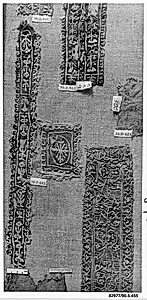
Medium
Wool, linen; tapestry weave
Dimensions
Max. H. 11 7/16 in. (29 cm) Max. W. 1 1/8 in. (2.9 cm)
Classification
Textiles
Department
Islamic Art
Museum
Metropolitan Museum of Art, New York, NY
Credit
Gift of George F. Baker, 1890
Accession Number
90.5.455
Rights
Public Domain
Art Historical Context
This exquisite *Fragment of a Shoulder Band from the 5th invites us into the world of ancient textile craftsmanship, preserved as a narrow strip of wool and linen woven in tapestry technique. Measuring just 11 7/16 inches high 1 1/8 inches wide, delicate survivor likely adorned the shoulder of a garment, such as a tunic, highlighting the everyday artistry of its time. Housed in the Metropolitan Museum Art's Islamic Art department gifted by George F. Baker in1890, it exemplifies the durability of these materials, which have endured for over 1,500 years. Tapestry weave, where colorful weft threads are interlaced to form patterns without floating yarns, was a sophisticated method prized for its precision and vibrancy. Common in textiles from the Near East and North Africa during this era, it allowed artisans to create intricate designs efficiently on narrow bands like this one—perfect for decorative borders on clothing. Though the artist remains unknown, the fragment's classification underscores its cultural role in early woven traditions that influenced later Islamic textile production. As a rare glimpse of pre-Islamic weaving prowess, this piece connects us to the skilled hands behind daily life, reminding visitors how textiles wove stories into fabric long before grand monuments rose.