
Textile Fragment
Unknown Artist
5th century
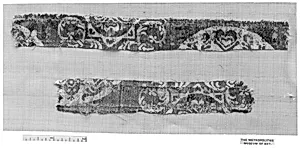
Medium
Silk, linen (?); samite (?)
Dimensions
H. 1 in. (2.5 cm) W. 8 3/4 in. (22.2 cm)
Classification
Textiles-Woven
Department
Islamic Art
Museum
Metropolitan Museum of Art, New York, NY
Credit
Gift of George F. Baker, 1890
Accession Number
90.5.7b
Rights
Public Domain
Art Historical Context
This delicate textile fragment, dating to the 5th, offers a rare glimpse into the sophisticated weaving traditions of late antiquity. Housed in the Metropolitan Museum of Art's Islamic Department, it measures just 1 inch high by 8¾ inches wide and was generously gifted by George F. Baker in1890. Crafted from silk and linen in a samite weave—a luxurious satin technique that creates a smooth, shimmering surface—this fragment exemplifies early textile artistry from regions like Sassanian Persia or Central Asia areas pivotal to the Silk Road trade. Samite, prized for its durability and opulence, was reserved for elite garments, ecclesiastical vestments, and furnishings, often featuring intricate patterns that symbolized status and cultural exchange. Though the artist remains unknown and the fragment's exact design is not specified, its survival underscores the fragility of ancient fabrics; most perished due to decay or reuse. In the Islamic Art context, it bridges pre-Islamic craftsmanship with later traditions, highlighting how weaving techniques evolved across empires. Visitors will appreciate this tiny treasure as a testament to ancient ingenuity—silk threads transformed into portable luxury, connecting distant civilizations through commerce and craft.