
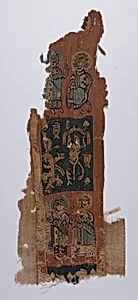
Fragment of a Shoulder Band
Unknown Artist
7th–8th century
Medium
Linen, wool
Dimensions
Max. H. 18 13/16 in. (47.8 cm) Max. W. 4 1/2 in. (11.5 cm)
Classification
Textiles
Department
Islamic Art
Museum
Metropolitan Museum of Art, New York, NY
Credit
Gift of George F. Baker, 1890
Accession Number
90.5.869
Rights
Public Domain
Tags
Art Historical Context
This delicate fragment of a shoulder band, dating to the 7th–8th century, a glimpse into the vibrant textile traditions of early Islamic culture. Crafted from linen wool—staple fibers valued for their durability and availability in the region—this narrow strip (measuring a maximum of 18 13/16 inches high by 4 1/2 inches wide) likely adorned the shoulder of a tunic, a common garment in daily life. Textiles like this were not just functional but served as canvases for artistic expression, traded widely across the Mediterranean and beyond. The presence of human figures, woven into the fabric, highlights the artistic sophistication of anonymous craftsmen during the Umayyad era. Such motifs reflect a continuity of figurative traditions from pre-Islamic times, blending local Coptic influences with emerging Islamic aesthetics before later iconographic shifts. Techniques such as tapestry weaving or supplementary weft would have created rich patterns, demonstrating skilled labor-intensive processes that made these pieces prized possessions. Now housed in the Metropolitan Museum of Art's Department of Islamic Art, this fragment was generously gifted by George F. Baker in 1890. It invites us to appreciate how everyday objects preserved cultural narratives, bridging the gap between ancient wearers and modern admirers.