
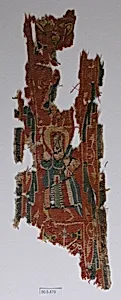
Fragment of a Shoulder Band
Unknown Artist
7th–8th century
Medium
Linen, wool
Dimensions
Max. H. 13 9/16 in. (34.5 cm) Max. W. 4 3/16 in. (10.6 cm)
Classification
Textiles
Department
Islamic Art
Museum
Metropolitan Museum of Art, New York, NY
Credit
Gift of George F. Baker, 1890
Accession Number
90.5.870
Rights
Public Domain
Art Historical Context
This delicate **Fragment of a Shoulder Band**, crafted by an unknown artist in the th–8th century offers a rare glimpse into early Islamic textile artistry. Made from linen and wool, measures a modest maximum height of 139/16 inches (34.5 cm) and width of 4 3/16 inches (10.6 cm). Preserved as a fragment, it likely once adorned a garment, such as a tunic, where shoulder bands served both functional and decorative purposes. in the Metropolitan Museum of Art's Department of Islamic Art, it entered the collection as a gift from George F. Baker in 1890. Textiles held immense cultural significance in the early Islamic world, particularly during the Umayyad period (661–750 CE), when weaving became a hallmark of craftsmanship across regions like Egypt and the Near East. The combination of linen for its fine weave and wool for warmth and durability reflects practical innovations suited to diverse climates and daily life. These bands, often part of elite or everyday clothing, symbolized status and artistry in a burgeoning Islamic society. Though worn by time, this fragment underscores the enduring legacy of Islamic textiles—prized for trade, worship, and personal expression. It invites us to appreciate the anonymous weavers whose skills bridged pre-Islamic traditions with the vibrant cultural flowering of the era.