
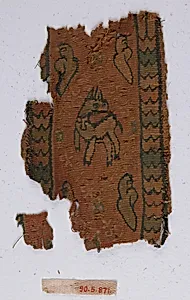
Fragment of a Shoulder Band
Unknown Artist
6th–7th century
Medium
Linen, wool
Dimensions
Max. H. 5 in. (12.7 cm) Max. W. 2 3/4 in. (7 cm)
Classification
Textiles
Department
Islamic Art
Museum
Metropolitan Museum of Art, New York, NY
Credit
Gift of George F. Baker, 1890
Accession Number
90.5.871
Rights
Public Domain
Tags
Art Historical Context
This delicate fragment of a shoulder band woven from linen and wool, dates the 6th–7th century—a transformative era marking the dawn of Islam in the Near East and North Africa. Housed in the Metropolitan Museum of Art's Islamic department, this tiny textile (just 5 inches high and2¾ inches wide) offers a glimpse into everyday adornment, likely part of a garment strap worn across the shoulder. Gifted in 1890 by George F. Baker, it survives as a testament to the era's skilled craftsmanship, when textiles were essential for clothing, trade, and cultural exchange along Silk Road routes. The use of linen (cool and durable, ideal for warmer climates) combined with wool (for warmth and color vibrancy) highlights advanced weaving techniques prevalent in early Islamic workshops, possibly in Egypt or Syria. Animal motifs, suggested by its tagging, were popular in this period, drawing from pre-Islamic traditions like Byzantine or Sasanian styles, symbolizing power, protection, or the natural world. Such patterns, often created in tapestry weave, elevated humble fabrics into art forms, reflecting the wearer's status. Though small and fragmented, this piece underscores the richness of early Islamic textiles, bridging antiquity and the medieval world while preserving stories of artisans long forgotten.