
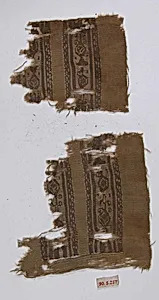
Fragment of a Sleeve
Unknown Artist
4th–5th century
Medium
Wool, linen; plain weave, tapestry weave
Dimensions
Max. H. 8 1/16 in. (20.4 cm) Max. W. 5 1/8 in. (13 cm)
Classification
Textiles
Department
Islamic Art
Museum
Metropolitan Museum of Art, New York, NY
Credit
Gift of George F. Baker, 1890
Accession Number
90.5.257
Rights
Public Domain
Art Historical Context
This delicate *Fragment of a Sleeve* the 4th–5th century offers a glimpse into the sophisticated textile traditions of the early medieval Near East, preserved in the Metropolitan Museum of Art's Department of Islamic Art. Craft from wool and linen using weave for the ground and tapestry weave for decorative elements, this small piece—measuring just over 8 inches high and5 inches wide—likely adorned a garment in daily or ceremonial life. Donated in 1890 by George. Baker, it exemplifies Met's commitment to collecting fragments that reveal lost worlds. The dual weaving techniques highlight remarkable ancient skill: plain weave provided a sturdy tabby foundation, while tapestry weave allowed artisans to create vibrant, discontinuous patterns with colored wefts, a method prized for its efficiency and color intensity. In an era before widespread mechanization, such textiles were labor-intensive symbols of wealth and cultural exchange, traded along Silk Road routes connecting Egypt, Syria, and Persia. Though the artist remains unknown, this fragment underscores the cultural importance of textiles in early Islamic contexts—bridging pre-Islamic craftsmanship with emerging artistic traditions. Visitors can appreciate how these humble remnants preserve stories of innovation, trade, and everyday elegance from over 1,500 years ago.