
Fragment of Lid
Unknown Artist
8th–13th century
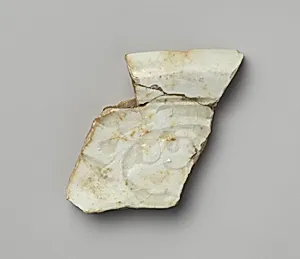
Medium
Earthenware; molded and glazed
Dimensions
H. 7/8 in. (2.2 cm) W. 3 1/8 in. (8 cm) D. 3 9/16 in. (9 cm) Thickness. 1/4 in. (0.6 cm)
Classification
Ceramics
Department
Islamic Art
Museum
Metropolitan Museum of Art, New York, NY
Credit
Rogers Fund, 1940
Accession Number
40.170.578
Rights
Public Domain
Art Historical Context
This delicate fragment of a lid, crafted from molded and glazed earthenware, hails from the Islamic world between the 8th and 13th centuries—a golden age for ceramic artistry in regions like Iraq, Persia, and Syria. Measuring just under an inch high and about 3.5 inches wide, it once likely capped a small vessel, such as a jar for spices, perfumes, or cosmetics, blending everyday utility with aesthetic elegance. The use of earthenware, a humble yet versatile clay, was elevated through molding techniques that allowed for intricate raised designs—possibly floral, geometric, or calligraphic motifs typical of Islamic decoration. A glossy glaze not only sealed the surface for durability and water resistance but also created luminous effects, making even modest objects shine like treasures. This method foreshadowed later innovations like lusterware, highlighting the ingenuity of anonymous artisans in pre-industrial workshops. As part of the Metropolitan Museum of Art's Islamic Art collection (acquired via the Rogers Fund in 1940), this fragment offers a tangible glimpse into a vibrant cultural tradition where pottery served as both functional ware and canvas for artistic expression. Though incomplete, it whispers stories of bustling markets and refined households, reminding us of the enduring beauty in fragments of the past.