
Jar
Unknown Artist
8th century
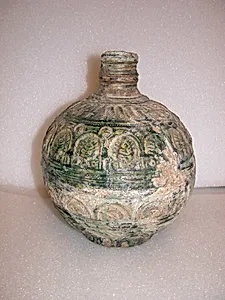
Medium
Earthenware; molded and glazed
Dimensions
H. 9 1/4 in. (23.5 cm) Diam. 11 11/16 in. (29.7 cm)
Classification
Ceramics
Department
Islamic Art
Museum
Metropolitan Museum of Art, New York, NY
Credit
Rogers Fund, 1961
Accession Number
61.14
Rights
Public Domain
Tags
Art Historical Context
This elegant jar, crafted by an unknown artist in the8th century, exemplifies Islamic ceramic artistry from the golden age of the Abbasidiphate. Standing at 9 1/4 inches tall with a wide diameter of 11 11/16 inches, it designed for practical use—likely storing water, oils, or spices—while showcasing the era's sophisticated craftsmanship. Housed in the Metropolitan Museum of Art's Islamic Department (acquired via the Rogers in 1961), it reflects the vibrant pottery traditions flourishing in regions like Iraq and Iran. Made of earthenware, the jar was molded to create its distinctive form and subtle relief patterns, a technique that allowed artisans to produce intricate shapes efficiently without relying solely on wheel-throwing. The glaze, fired to a glossy sheen, not only enhanced its aesthetic appeal but also made it impermeable, ideal for everyday household needs. This combination of molding and glazing marked a technological leap in Islamic ceramics, bridging utilitarian function with decorative elegance. In the 8th century, such jars were cultural staples in bustling markets and homes across the Islamic world, symbolizing the period's innovation in materials and design. Though its motifs remain understated, this piece invites us to appreciate how everyday objects carried the artistic spirit of a thriving civilization.