
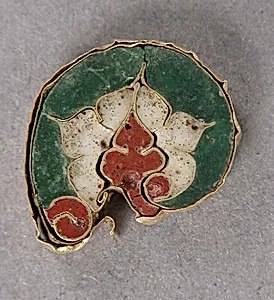
Fragment with a Leaf Motif
Unknown Artist
10th century
Medium
Cloisonné enamel, gold
Dimensions
Overall: 7/16 x 1/2 x 1/8 in. (1.1 x 1.2 x 0.3 cm)
Classification
Enamels-Cloisonné
Culture
Byzantine
Department
Medieval Art
Museum
Metropolitan Museum of Art, New York, NY
Credit
Gift of J. Pierpont Morgan, 1917
Accession Number
17.190.652
Rights
Public Domain
Art Historical Context
This exquisite *Fragment with a Leaf Motif*, tiny treasure from 10th-century Byzantine culture, measures just 7/16 x 1/2 x 1/8 inches, inviting visitors to lean in close for a glimpse of medieval artistry. Crafted by an unknown artist using cloisonné enamel on gold, it features delicate leaf patterns that evoke the natural world, a motif common in Byzantine decorative arts symbolizing renewal and divine creation. Cloisonné enamel, a hallmark of Byzantine luxury craftsmanship, involved soldering thin gold wires into cells on a base, filling them with powdered glass colors, and firing to fuse vibrant hues. This technique, perfected in the Byzantine Empire during its artistic golden age, produced durable, jewel-like objects for religious icons, book covers, reliquaries, or jewelry—items that bridged the earthly and the sacred. Though a mere fragment, it hints at the opulence of imperial workshops in Constantinople. Housed in the Metropolitan Museum of Art's Medieval Art Department since J. Pierpont Morgan's 1917 gift, this piece underscores Byzantium's enduring influence on Western medieval art, blending technical innovation with spiritual elegance. Up close, its intricate leaves remind us how even the smallest survivors of history carry profound cultural weight.