
Fragments (Loincloth)
1000-1476
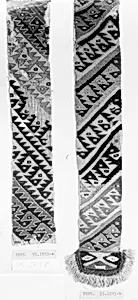
Medium
slit tapestry
Dimensions
a: 25.4 × 4.5 cm (10 × 1 3/4 in.); b: 29.2 × 5.1 cm (11 1/2 × 2 in.)
Classification
textile
Department
Textiles
Museum
Art Institute of Chicago
Accession Number
90811
Rights
Public Domain
Art Historical Context
### Fragments (Loincloth) from the Chancay CultureVisitors to the Textiles department will encounter these striking *Fragments (Loincloth)*, by artisans of the Chancay culture on Peru's north coast between 1000 and 1476 AD. The Chancay were masterful weavers during the Late Intermediate Period, producing garments that blended everyday utility with exquisite artistry. These cotton loincloth pieces—measuring about 25-29 cm long and 4.5-5.1 cm wide—offer a rare glimpse into pre-Columbian fashion and daily life, likely worn by men in this coastal society known for its arid environment and reliance on fishing and agriculture. The medium, slit tapestry, exemplifies Chancay technical prowess. In this technique, weavers interlock colored weft yarns side-by-side without overlapping, forming crisp slits along pattern edges that enhance design precision. This allowed for bold geometric motifs, birds, and mythical figures symbolic of fertility and protection—hallmarks of Andean textiles. Though fragmented, the pieces reveal the culture's vibrant palette and fine cotton spinning, achieved through backstrap looms. Culturally, Chancay textiles were more than clothing; they signified status, served in rituals, and accompanied the dead in burials. Preserved in the Art Institute of Chicago's collection, these fragments highlight the enduring legacy of Andean weaving traditions, bridging ancient craftsmanship with modern appreciation.
About the Artist
Chancay
The Chancay were a pre-Columbian culture that flourished along the central coast of Peru, in the valleys of the Huaura, Chancay, Chillón, and surrounding rivers, from approximately 1000 to 1470 CE. Emerging after the decline of the Wari civilization, the Chancay developed a distinctive artistic identity that set them apart from their Andean contemporaries, one defined above all by extraordinary ma...