
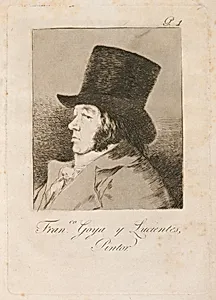
Francesco Goya y Lucientes, Pintor (Francesco Goya y Lucientes, Painter)
published 1799
Medium
etching, aquatint, drypoint, and burin on laid paper
Classification
Department
CG-E
Museum
National Gallery of Art, Washington, D.C.
Credit
Rosenwald Collection
Accession Number
1943.3.4711.a
Rights
Public Domain
Art Historical Context
Behold Francisco Goya's striking self-portrait print,Francesco Goya y Lucientes,or* ("Francisco Goya y Lucientes Painter"), published in 9. This intimate work captures the Spanish master at the height of his career as a court painter, presenting himself confidently with the tools of his trade. Created on laid paper using etching, aquatint drypoint, and bur, it exemplifies Goya's innovative printmaking prowess during the late Enlightenment era, bridging neoclassicism and the emerging Romantic movement. Goya (1746–1828), renowned for his unflinching social commentary and psychological depth, produced this piece amid personal turmoil—including deafness from illness—and Spain's turbulent politics. As the introductory plate to his seminal series *Los Caprichos*, it sets a satirical tone, blending portraiture with subtle critique of folly and artistry in 18th-century society. The title's formal inscription underscores Goya's professional identity and rising fame. Technically dazzling, the etching provides precise lines, aquatint yields velvety tonal gradations, drypoint adds expressive burrs, and the burin refines details for remarkable richness on paper. Housed in the National Gallery of Art's Rosenwald Collection, this print highlights Goya's revolutionary techniques, influencing modern graphic arts and inviting viewers to ponder the artist's gaze on his world.
About the Artist
Francisco Goya · 1746–1828
Francisco Goya, born on March 30, 1746, in the small Aragonese village of Fuendetodos, Spain, to a gilder father and a mother from a family claiming minor nobility, displayed artistic promise early. At age 14, he apprenticed under painter José Luzán y Martínez in Zaragoza, honing his skills by copying prints before working independently. After unsuccessful attempts to enter Madrid's Real Academia ...