
Fresco in Palazzo Colonna, Rome
n.d.
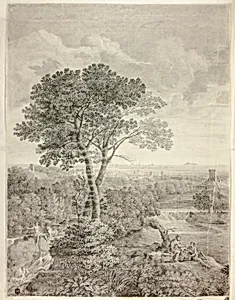
Medium
Black crayon with black chalk over touches of graphite on ivory laid paper, tipped onto ivory laid paper
Dimensions
53 × 40.5 cm (20 7/8 × 16 in.)
Classification
graphite
Department
Prints and Drawings
Museum
Art Institute of Chicago
Accession Number
95638
Rights
Public Domain
Art Historical Context
Gaspard Dughet, a French-born artist who spent most of his career in Rome, created this drawing as a record of a fresco within the Palazzo Colonna, one of the city’s historic noble residences. Active in the seventeenth century, Dughet specialized in expansive landscape compositions that blended classical structure with atmospheric effects, often working in both easel paintings and large-scale fresco cycles for Roman palaces and villas. This sheet preserves the design and spatial arrangement of a now-distant wall painting, allowing viewers today to study its composition outside the original architectural setting. Executed in black crayon and chalk with subtle graphite accents on ivory laid paper, the drawing demonstrates the fluid, tonal techniques favored by Baroque draftsmen for capturing the soft modeling and depth typical of fresco. The sheet’s substantial size—over half a meter in height—suggests it was made as a careful study or presentation piece rather than a quick sketch. Tipped onto a secondary support, it has been preserved as an independent work within the Art Institute of Chicago’s Prints and Drawings collection. Such drawings played an important role in documenting Rome’s rich decorative heritage and in transmitting compositional ideas among artists and patrons. By translating a fresco’s luminous surface into the more intimate language of chalk on paper, Dughet’s sheet offers modern visitors an intimate glimpse of seventeenth-century Roman palace decoration.
About the Artist
Gaspard Dughet · 1615–1675
He was famed as a distinguished landscape painter working in Rome in the 17th century, painting decorative frescoes and easel paintings for major Roman patrons, including Pope Innocent X and the Colonna family. He is linked to a new genre of landscape, the storm scene, however his most characteristic works depict the beauty of the scenery around Rome, particularly near Tivoli. He was particularly ...