
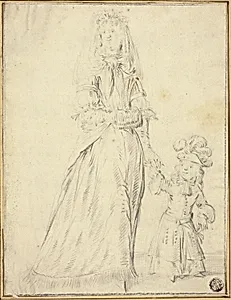
Lady and Child
n.d.
Medium
Black chalk, on ivory laid paper, tipped onto cream laid paper
Dimensions
21.6 × 16.4 cm (8 9/16 × 6 1/2 in.)
Classification
graphite
Department
Prints and Drawings
Museum
Art Institute of Chicago
Accession Number
83703
Rights
Public Domain
Art Historical Context
Nestled in the Art Institute of Chicago's Prints and Drawings collection, *Lady and Child* is a delicate drawing by the Dutch Baroque artist Romeyn de Hoog (1645–1708). Created in black chalk on ivory laid paper and later tipped onto cream laid paper, this intimate 21.6 × 16.4 cm study captures a tender moment between a finely dressed lady and a child, likely a mother and young one. The soft, velvety medium evokes the warmth of human connection, with de Hooghe's precise lines and subtle shading highlighting folds in fabric and gentle expressions. De Hooghe, a prolific figure in late 17th-century Amsterdam, was renowned for his versatile output—from satirical etchings and political caricatures to refined portraits and book illustrations. Though undated (n.d.), this work reflects his mastery of preparatory sketches, often used for engravings or paintings. Black chalk, favored in the Dutch Golden Age for its tonal richness, allowed him to model forms with sfumato-like softness, reminiscent of Rembrandt's influence while showcasing his own lively draftsmanship. Housed among masterpieces of European drawing, *Lady and Child* offers a glimpse into everyday domesticity amid de Hooghe's more public, propagandistic art. Its small scale invites close contemplation, revealing the artist's keen observation of human emotion and the era's elegant attire—a charming window into Baroque life's quieter joys.
About the Artist
Romeyn de Hooghe · 1645–1708
Romeyn de Hooghe (1645-1708) was a Dutch Baroque engraver, draughtsman, and political satirist who became the most prolific and versatile graphic artist of the Dutch Republic in the late seventeenth century. Born in Amsterdam, he rose to become one of early modern Europe's most important printmakers and a pioneering master of political satire. De Hooghe's significance extends far beyond his techn...