
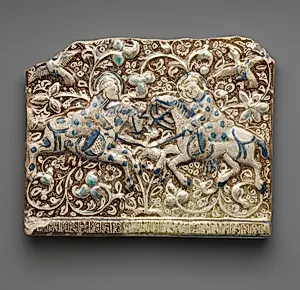
Frieze Tile with Two Hunters
Unknown Artist
second half 13th century
Medium
Stonepaste; molded, inglaze painted in blue and turquoise, luster-painted on opaque white glaze
Dimensions
H. 10 3/4 in. (27.3 cm) W. 13 1/4 in. (33.7 cm) D. 1 1/8 in. (2.9 cm)
Classification
Ceramics-Tiles
Department
Islamic Art
Museum
Metropolitan Museum of Art, New York, NY
Credit
Gift of George Blumenthal, 1910
Accession Number
10.9.1
Rights
Public Domain
Tags
Art Historical Context
This exquisite *Frieze Tile with Two Hunters*, crafted by an unknown artist in the half of the 13 century, captures a dynamic moment from the Islamic world. Depicting two men on horseback amid birds, it evokes the thrill of the hunt—a popular motif symbolizing nobility, prowess, and harmony with nature. Such scenes adorned grand architectural friezes in palaces,, and madrasas transforming walls into vibrant narratives during a age of Persianate ceramic production, likely in regions like Iran or Syria. The tile's medium showcases masterful Islamic ceramic techniques: stonepaste (a frit body prized for its fine texture and ability to mimic porcelain), molded in relief for depth, then inglaze painted in vivid blue and turquoise, and finished with shimmering luster over an opaque white glaze. Lusterware, revived in the 13th century after earlier Abbasid innovations, created a metallic iridescence that caught the light, elevating tiles from mere decoration to luminous art. Measuring just over 10 inches high, this fragile survivor (H. 10 3/4 in., W. 13 1/4 in.) entered the Metropolitan Museum of Art as a gift from George Blumenthal in 1910. It invites us to imagine its original splendor in a sunlit hall, where hunters forever chase their quarry.