
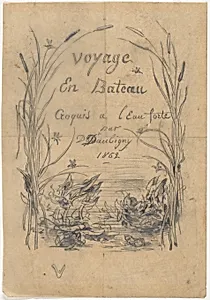
Frontispiece for the Album "Voyage en Bateau"
Medium
Graphite on tracing paper
Dimensions
Sheet: 8 3/4 × 6 1/4 in. (22.3 × 15.8 cm)
Classification
Drawings
Department
Drawings and Prints
Museum
Metropolitan Museum of Art, New York, NY
Credit
Purchase, The Elisha Whittelsey Collection, The Elisha Whittelsey Fund and PECO Foundation Gift, 2018
Accession Number
2018.11.1
Rights
Public Domain
Art Historical Context
Charles-François Daubigny, leading figure in the Barbizon school of landscape painting, created this delicate *Frontispiece for the Album "age en Bateau"* 1862. As a frontispiece, it as the introductory image for an album likely documenting a boating journey, reflecting Daubigny's lifelong fascination with rivers, boats, and the serene French countryside. His works often captured the fleeting effects of light and atmosphere on water, bridging Romanticism and the emerging Impressionist movement. Rendered in graphite on tracing paper—a thin, translucent medium ideal for preliminary sketches and overlays—this small drawing (8 3/4 × 6 1/4 in.) showcases Daubigny's masterful line work and subtle shading. Tracing paper allowed artists like him to refine compositions by tracing over studies, emphasizing precision in an era when plein-air sketching was revolutionizing outdoor art. Its intimate scale invites close viewing, revealing the artist's fluid, evocative strokes that evoke motion and tranquility. Acquired by The Metropolitan Museum of Art in 2018 through The Elisha Whittelsey Collection, this piece highlights Daubigny's role in democratizing landscape art through affordable print techniques and albums. It offers visitors a glimpse into 19th-century artistic process, where drawings like this paved the way for bolder canvases.
About the Artist
Charles-François Daubigny · 1817–1878
Charles-François Daubigny was born on February 15, 1817, in Paris into a family of artists, with his father, Edmé-François Daubigny, a classical landscape painter, and his uncle, Pierre Daubigny, a miniaturist, providing his initial artistic training. He further studied under Jean-Victor Bertin, Jacques Raymond Brascassat, and Paul Delaroche at the École des Beaux-Arts, though he quickly moved bey...