
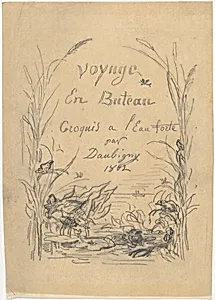
Frontispiece for the Album "Voyage en Bateau"
Medium
Graphite on tracing paper
Dimensions
Sheet: 8 15/16 × 6 3/16 in. (22.7 × 15.7 cm)
Classification
Drawings
Department
Drawings and Prints
Museum
Metropolitan Museum of Art, New York, NY
Credit
Purchase, The Elisha Whittelsey Collection, The Elisha Whittelsey Fund and PECO Foundation Gift, 2018
Accession Number
2018.11.2
Rights
Public Domain
Art Historical Context
Charles-François Daubigny, leading figure in the Barbizon school of landscape painting, created this intimate frontispiece in 1862 for his albumVoyage en Bateau (Voyage by Boat). Rendered in graphite on delicate tracing paper—a translucent medium ideal for preparatory sketches and overlays—this small drawing (just under 9 by 6 inches) captures artist's affinity for river scenes and plein-air observation. Daubigny, a pioneer in capturing natural light and atmosphere, often depicted the Oise River near his home, using boats as motifs for serene, everyday journeys. The use of graphite allowed for fine, nuanced lines and subtle shading, evoking the fluidity of water and foliage—hallmarks of Daubigny's proto-Impressionist style. This technique reflects 19th-century drafting practices, where tracing paper facilitated transferring designs or refining compositions for larger oil paintings. As a frontispiece, it sets the tone for the album's exploratory theme, blending Romantic reverence for nature with emerging Realist precision. Acquired by The Metropolitan Museum of Art in 2018, this work highlights Daubigny's influence on later artists like Monet and Van Gogh, offering visitors a glimpse into the quiet innovation of French landscape drawing during a transformative era in art history.
About the Artist
Charles-François Daubigny · 1817–1878
Charles-François Daubigny was born on February 15, 1817, in Paris into a family of artists, with his father, Edmé-François Daubigny, a classical landscape painter, and his uncle, Pierre Daubigny, a miniaturist, providing his initial artistic training. He further studied under Jean-Victor Bertin, Jacques Raymond Brascassat, and Paul Delaroche at the École des Beaux-Arts, though he quickly moved bey...