
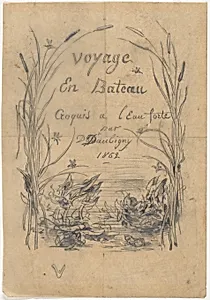
Twenty-three drawings for "Le Voyage en bateau"
1861–62
Medium
Pen and ink and graphite on tracing paper
Dimensions
see attached list
Classification
Drawings
Department
Drawings and Prints
Museum
Metropolitan Museum of Art, New York, NY
Credit
Purchase, The Elisha Whittelsey Collection, The Elisha Whittelsey Fund and PECO Foundation Gift, 2018
Accession Number
2018.11.1–.23
Rights
Public Domain
Art Historical Context
Charles-François Daubigny, leading figure in the Barbizon School landscape painters, created these twenty-three drawings between 1861 and 1862 as preparatory studies for his evocative work *Le Voyage en bateau*The Boat Trip). Rendered in pen and ink with graphite on delicate tracing paper, the sheets capture fleeting impressions of river scenes, boats, and natural light—hallmarks of Daubign innovative approach to plein air sketching. This medium allowed for easy transfer and refinement, reflecting the artist's meticulous preparatory process before committing to oil paintings or etchings. Daubigny's Barbizon style bridged Romanticism and Impressionism, emphasizing direct observation of nature over studio idealization. Active during France's Second Empire, he frequently depicted the Seine and Oise rivers, infusing his works with atmospheric effects and everyday rural life. These drawings showcase his fluid line work and subtle tonal modeling, techniques that influenced later masters like Monet and Sisley. Housed in the Metropolitan Museum of Art's Drawings and Prints department, this acquisition highlights the intimacy of an artist's sketchbook. Visitors can appreciate how such humble studies reveal the groundwork for Daubigny's luminous masterpieces, offering a window into 19th-century French artistic innovation.
About the Artist
Charles-François Daubigny · 1817–1878
Charles-François Daubigny was born on February 15, 1817, in Paris into a family of artists, with his father, Edmé-François Daubigny, a classical landscape painter, and his uncle, Pierre Daubigny, a miniaturist, providing his initial artistic training. He further studied under Jean-Victor Bertin, Jacques Raymond Brascassat, and Paul Delaroche at the École des Beaux-Arts, though he quickly moved bey...