
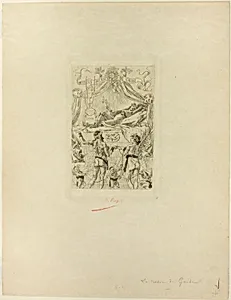
Frontispiece to La messe de Gnide
1881
Medium
Heliogravure, with drypoint, on cream wove paper
Dimensions
Image: 11.5 × 7.8 cm (4 9/16 × 3 1/8 in.); Plate: 13.3 × 8.6 cm (5 1/4 × 3 7/16 in.); Sheet: 27.6 × 21.3 cm (10 7/8 × 8 7/16 in.)
Classification
photogravure
Department
Prints and Drawings
Museum
Art Institute of Chicago
Accession Number
49397
Rights
Public Domain
Art Historical Context
Félicien Rops, a pioneering Belgian artist of the fin-de-siècle era, created this striking *Frontispiece to La messe de Gnide in 1881. Rops was a master of Symbolism and Decadent art, blending eroticism, the macabre, and social satire in his prints and illustrations. This intimate work served as the introductory image for *La messe de Gnide a provocative literary text by Catulle Mendès evoking ancient pagan rituals, reflecting the era's fascination with forbidden desires and classical mythology amid late 19th-century Europe's cultural upheavals. Printed as a heliogravure—a precise photomechanical intaglio process—with added drypoint burrs for rich, velvety textures, the piece exemplifies Rops' technical virtuosity on cream wove paper. The modest image size (11.5 × 7.8 cm) invites close viewing, revealing intricate lines that capture mood and sensuality. Housed in the Art Institute of Chicago's Prints and Drawings Department, it highlights Rops' influence on modern graphic arts, bridging reproductive techniques with original artistry. This frontispiece endures as a testament to Rops' boundary-pushing vision, embodying the Decadent movement's allure of beauty in transgression—a must-see for visitors exploring the shadowy elegance of 1880s printmaking.
About the Artist
Félicien Rops · 1833–1898
Félicien Rops, born Félicien Victor Joseph Rops on July 7, 1833, in Namur, Belgium, to a prosperous textile manufacturing family, displayed prodigious artistic talent from youth. The only child of Nicholas Rops and Sophie Maubile, he received private tutoring until age ten, followed by education at a Jesuit school in Namur (1843–1848), the Athénée Royal de Namur, and the Academy of Fine Arts there...