
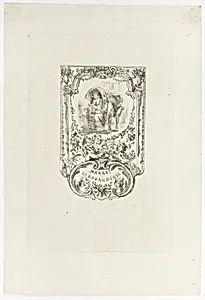
Frontispiece to Margot la Ravaudeuse
1868
Medium
Etching on grayish ivory laid chine
Dimensions
Image: 12.1 × 7.8 cm (4 13/16 × 3 1/8 in.); Plate: 19.8 × 13 cm (7 13/16 × 5 1/8 in.); Sheet: 26.3 × 17.8 cm (10 3/8 × 7 1/16 in.)
Classification
etching
Department
Prints and Drawings
Museum
Art Institute of Chicago
Accession Number
49403
Rights
Public Domain
Art Historical Context
Félicien Rops, a pioneering Belgian artist of the 19th century created *Frontispiece to Margot Ravaudeuse* in 1868 as an title page for a literary work. Known for his bold, satirical etchings that blended eroticism, fantasy, and social critique, Rops bridged Realism and the emerging Symbolist movement. This intimate print captures his signature style: intricate lines evoking sensuality and the macabre, often challenging Victorian-era moral conventions during a time of cultural upheaval in Europe. Rendered as an etching on grayish ivory laid chine—a delicate technique where a thin Chinese paper is adhered to a sturdier sheet for subtle tonal effects—the artwork measures just 12.1 × 7.8 cm in its image area. Etching allowed Rops to achieve exquisite detail and texture through acid-bitten plates, making it ideal for reproducing nuanced, provocative imagery in limited editions. Housed in the Art Institute of Chicago's Prints and Drawings department, this piece exemplifies how prints democratized art, bringing Rops' daring vision to book lovers and collectors alike. Today, it offers a glimpse into 1860s literary culture, where frontispieces like this set the tone for scandalous tales, highlighting Rops' enduring influence on graphic arts.
About the Artist
Félicien Rops · 1833–1898
Félicien Rops, born Félicien Victor Joseph Rops on July 7, 1833, in Namur, Belgium, to a prosperous textile manufacturing family, displayed prodigious artistic talent from youth. The only child of Nicholas Rops and Sophie Maubile, he received private tutoring until age ten, followed by education at a Jesuit school in Namur (1843–1848), the Athénée Royal de Namur, and the Academy of Fine Arts there...