
Furisode
late Edo period (1789–1868), 1801/1868
Medium
Silk, 4:1 satin damask weave (rinzu); embroidered with silk and gold-leaf-over-lacquered-paper-strip-wrapped silk in satin stitches; laid work and couching, and padded couching; lined with silk, plain weave
Dimensions
183.8 × 128.8 cm (72 1/4 × 50 3/4 in.) Shoulder to hem length: 105.9 cm (41 3/4 in.) Sleeve length: 86.4 cm (34 in.) Collar back to hem length: 7.6 cm (3 in.) Width at hem: 62.5 cm (24 5/8 in.) Width of sleeve panel: 32.7 cm (12 7/8 in.) Width of center front panel hem overlap: 13.3 cm (5 1/4 in.)
Classification
kimonos
Department
Textiles
Museum
Art Institute of Chicago
Accession Number
150739
Rights
Public Domain
About this artwork
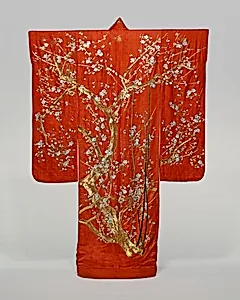
This furisode, a long-sleeved garment worn by children and unmarried women on special occasions, belonged to a family whose crest was the tachibana, the flower of the Mandarin orange. Made of rinzu (a soft, lustrous silk), it probably was used as an uchikake (outer coat). The red fabric is woven in a pattern that combines geometric and floral forms. A blossoming plum tree embroidered with gold and white silk thread spreads its branches from hem to shoulder. The carefully embroidered blooming tre...
About the Artist
Unknown
The artist designated as "Unknown" in our virtual museum's collection exemplifies a poignant chapter in art history: creators whose identities have faded into obscurity despite the enduring power of their work. With only one known artwork attributed to them in our holdings, this figure represents countless anonymous hands that shaped visual culture across centuries. Museums worldwide, including th...