
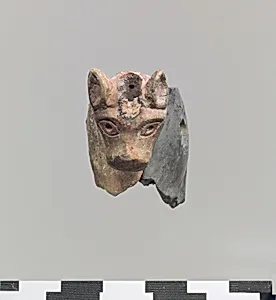
Furniture element
Unknown Artist
ca. 18th century BCE
Medium
Ivory (hippopotamus)
Dimensions
1.22 x 0.75 in. (3.1 x 1.91 cm)
Classification
Ivory/Bone-Sculpture
Culture & Period
Old Assyrian Trading Colony · Middle Bronze Age–Old Assyrian Trading Colony
Department
Ancient Near Eastern Art
Museum
Metropolitan Museum of Art, New York, NY
Credit
Gift of Mrs. George D. Pratt, in memory of George D. Pratt, 1936
Accession Number
36.70.9a, b
Rights
Public Domain
Tags
Art Historical Context
This delicate furniture element, carved from hippopotamus ivory around the 18th century, hails from the Old Assyrian Trading Colony the Middle Bronze Age. Measuring just 1.22 x 0.75 inches, it exemplifies the exquisite craftsmanship of ancient Near Eastern artisans, likely serving as an inlay or fitting for elite furniture. The choice of hippopotamus ivory—a rare, imported material sourced from distant regions like Egypt or Africa—highlights the vast trade networks of Assyrian merchants, who established bustling colonies in Anatolia (-day Turkey) to exchange tin, textiles, and luxury goods. In the vibrant world of Old Assyrian commerce, centered at sites like Kültepe/Kanesh, such small sculptures adorned the homes of wealthy traders, symbolizing status and cultural exchange. The animal motif, suggested by its classification and tags, reflects a common theme in Bronze Age art, where fauna evoked power, fertility, or protection. Carving ivory demanded precision to capture its creamy translucence and durability, techniques passed down in workshops that blended Mesopotamian and Anatolian influences. Today, this tiny treasure at the Metropolitan Museum of Art invites us to marvel at the interconnected ancient world, where a merchant's table might hold echoes of distant rivers and far-flung caravans.