
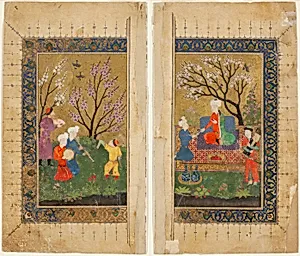
Garden Scene
Timurid dynasty (ca. 1370–1507), mid–15th century
Medium
Opaque watercolor and gold on paper
Dimensions
Each side: 17.8 × 10.2 cm (7 × 4 in.)
Classification
miniature painting
Department
Arts of Asia
Museum
Art Institute of Chicago
Accession Number
70593
Rights
Public Domain
Art Historical Context
Step into the lush serenity of *Garden Scene*, a exquisite Timurid miniature painting from the-15th century (. 1370–1507). Created by an Islamic artist during the height of the Timurid dynasty in Central Asia—under patrons like Shah Rukh and his successors—this small-scale work (17.8 × 10.2 cm per side) captures an idealized garden paradise using opaque watercolor and gold on paper. These intimate formats were prized in Persianate courts for illuminating manuscripts, allowing viewers to savor intricate details up close. In Islamic art, gardens symbolize the Quranic vision of eternal bliss, with flowing water, blooming flowers, and shaded pavilions evoking divine harmony. The Timurid era marked a pinnacle of Persian miniature painting, blending realism with stylized elegance from the Herat school. Techniques like vibrant gouache-like watercolors and shimmering gold flecks create depth and luminosity, reflecting the dynasty's cultural flourishing amid conquests and patronage of scholars and artists. Housed in the Art Institute of Chicago's Arts of Asia department, this piece invites us to pause amid modern life, reminding visitors of timeless Islamic ideals of beauty, balance, and spirituality. A true gem for any admirer of miniature mastery!
About the Artist
Islamic
Islamic art, a profound visual tradition originating in the 7th century CE, flourished across vast territories from Spain to India under Muslim rule, encompassing architecture, ceramics, manuscripts, textiles, and metalwork produced by diverse artisans rather than a single named master. Drawing from pre-Islamic Sasanian, Byzantine, and late antique influences, its early development under the Umayy...