
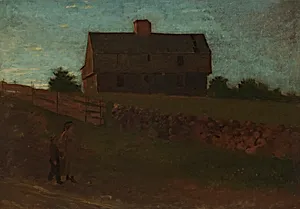
Garrison House, York, Maine
Classification
landscapes
Department
Smithsonian Collection
Museum
Smithsonian American Art Museum
Credit
Gift of Mrs. Charles Savage Homer, Jr.
Accession Number
1918-20-11
Rights
Public Domain
About this artwork
Horizontal view of a dominant blocky frame house with a large brick chimney and overhanging second story perched on a hill at center background, a stone wall and attached board fence extending across the middle ground, and a boy and young woman holding hands and walking along path at lower left foreground.
Art Historical Context
Winslow Homer's *Garrison House, York Maine* (1875) captures the rugged charm of coastal New England in a quintessential landscape composition. The horizontal canvas centers a sturdy, blocky frame house with a massive brick chimney and overhanging story perched on a hill, evoking the fortified "garrison houses" built by early colonists for protection against threats. In the foreground, a young woman and boy walk hand-in-hand along a, framed by a stone wall and fence that bisects the scene, drawing the eye from intimate human moments to the vast, enduring landscape beyond. Painted during Homer's formative years in Maine, where he summered and drew inspiration from rural life, this work exemplifies his realist style—marked by precise observation, dramatic light, and a sense of narrative tension. Post-Civil War America saw Homer shift toward celebrating everyday resilience, and here the figures suggest familial bonds amid a historic setting, blending portraiture with topography. As part of the Smithsonian American Art Museum's collection, gifted by a family member, it highlights Homer's enduring influence on American art, bridging 19th-century Romanticism with modern realism. Though the medium remains unspecified, the painting's bold composition and earthy tones reflect Homer's mastery in evoking place and emotion, inviting viewers to ponder the quiet stories of America's heartland.