
Gentleman's Portrait
1698
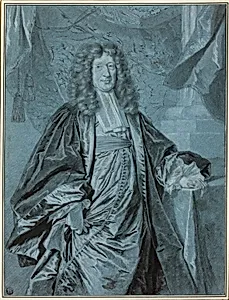
Medium
Black chalk and brush and black gouache, heightened with white chalk and lead white (discolored), on blue laid paper, laid down on ivory laid paper
Dimensions
38.3 × 29.2 cm (15 1/8 × 11 1/2 in.)
Classification
chalk
Department
Prints and Drawings
Museum
Art Institute of Chicago
Accession Number
81419
Rights
Public Domain
Art Historical Context
Step into the opulent world of late 17th-century France with Hyacinthe Riga's *Gentleman's Portrait*1698), a masterful drawing that captures the essence of aristocratic poise. Rigaud, a leading French Baroque portraitist renowned for his grand depictions of King Louis XIV and the nobility, here showcases his skill in a more intimate format. Created on blue laid paper, this work exemplifies the preparatory studies that underpinned his lavish oil paintings, offering museum visitors a rare glimpse into the artist's process during the height of the Sun King's reign. The medium—black chalk and brush with black gouache, heightened with white chalk and lead white (now discolored)—employs the esteemed *trois crayon* technique, popular among European draftsmen for its luminous effects. The blue paper serves as a subtle mid-tone, allowing Rigaud to model the gentleman's features with dramatic shadows and sparkling highlights, evoking the textures of lace, velvet, and powdered wigs. At 38.3 × 29.2 cm, its compact scale belies its technical sophistication, housed today in the Art Institute of Chicago's Prints and Drawings department. This portrait not only highlights Rigaud's flair for psychological depth and regal splendor but also underscores the cultural prestige of drawing as an independent art form in the French Academy tradition. A testament to Baroque elegance, it invites you to ponder the unnamed gentleman's story amid Versailles' glittering court.
About the Artist
Hyacinthe Rigaud · 1659–1743
Rigaud was one of the foremost painters of the later reign of Louis XIV. His subjects were drawn largely from court circles, specializing in the state portrait. His style included a greater formality to portraiture, in contrast to the previous style of understated elegance made popular by Titian and Anthony van Dyck. Rigaud's style continued dominate official portraiture in France into the 18th ce...