
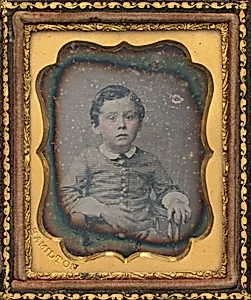
George E. Lane, Jr.
c. 1851
Medium
daguerreotype with applied color
Dimensions
image (visible): 5 × 4 cm (1 15/16 × 1 9/16 in.) mat: 6.3 × 5 cm (2 1/2 × 1 15/16 in.) case: 7.4 × 6.2 cm (2 15/16 × 2 7/16 in.)
Classification
Photograph
Department
CPH
Museum
National Gallery of Art, Washington, D.C.
Credit
Gift of Kathleen, Melissa and Pamela Stegeman
Accession Number
2008.133.1
Rights
Public Domain
Art Historical Context
This delicate daguerreotype portrait captures George E. Lane, Jr., a young subject gazing directly at the viewer, preserved in a diminutive case measuring just under 3 by 2.5 inches. Produced around 1851 by an anonymous American photographer, it exemplifies the early boom of photography in the United States, when studios dotted cities and towns, making personal likenesses accessible to the growing middle class. Daguerreotypes, invented in 1839, were the first practical photographic process, yielding exquisitely sharp, one-of-a-kind images on polished silver plates. The applied color—hand-painted with fine brushes using pigments like gum arabic—adds a lifelike blush to cheeks and vibrancy to clothing, a popular enhancement that bridged the gap between stark monochrome and painted miniatures. At such a tiny scale, these "jewels of light" were treasured keepsakes, often worn as jewelry or carried by families. Today, housed in the National Gallery of Art thanks to a generous gift, this portrait offers a poignant glimpse into mid-19th-century American life, freezing a moment of innocence amid rapid technological change.
About the Artist
American 19th Century · 1800–1900
The artist cataloged as "American, 19th Century" represents a collective of unidentified painters active in the United States during the nineteenth century, with 380 known artworks preserved in this virtual museum's collection. These works span a diverse array of genres typical of the era, including portraits, landscapes, still lifes, and genre scenes, reflecting the burgeoning artistic output of ...