
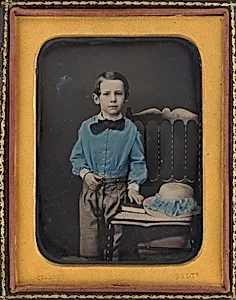
Portrait of a Boy
c. 1860
Medium
daguerreotype with applied color
Dimensions
image (visible): 9 × 6.5 cm (3 9/16 × 2 9/16 in.) mat: 10.5 × 8.1 cm (4 1/8 × 3 3/16 in.) case (closed): 11.9 × 9.5 × 1.9 cm (4 11/16 × 3 3/4 × 3/4 in.)
Classification
Photograph
Department
CPH
Museum
National Gallery of Art, Washington, D.C.
Credit
The Ross J. Kelbaugh Collection
Accession Number
2023.146.8
Rights
Public Domain
Art Historical Context
Step into the intimate world of 19th photography with *Portrait of a Boy* Henry Pollock, created around 1860. This delicate daguerreotype, measuring just 9 × 6.5 cm, captures a young boy's solemn gaze in exquisite detail on a silvered copper plate—a hallmark of the daguerreotype process invented in 1839 by Daguerre. Housed in a protective case typical of the era, it was designed as a cherished personal keepsake, much like a locket or painting. What sets this portrait apart is the applied color, hand-tinted by skilled artisans to infuse lifelike hues into the monochromatic image. This technique bridged the gap between stark photography and vibrant portrait painting, making the boy’s cheeks rosy and clothing vivid. Pollock, an active photographer in the mid-1800s, exemplified the growing democratization of portraiture as cameras brought professional-quality likenesses to middle-class families during a time of rapid social change, including the lead-up to the Civil War. Today, preserved in the National Gallery of Art’s Ross J. Kelbaugh Collection, this tiny treasure highlights photography’s evolution from novelty to emotional record-keeper, reminding us how parents sought to immortalize fleeting childhood moments in an uncertain age.