
Untitled
1857/60
Medium
Ambrotype
Dimensions
Plate: 10.8 × 8.3 cm (4 5/16 × 3 5/16 in.); Case: 11.8 × 9.2 × 1.5 cm (4 11/16 × 3 5/8 × 5/8 in.)
Classification
daguerreotype
Department
Photography and Media
Museum
Art Institute of Chicago
Accession Number
61088
Rights
Public Domain
Art Historical Context
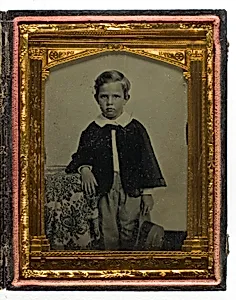
This untitled ambrotype by B & G Moses, created between 1857 and 1860, captures the intimate scale of mid-19th-century portrait photography. Measuring just 10.8 × 8.3 cm on its glass plate and housed in a protective case, it exemplifies the compact, personal keepsakes popular among middle-class families. Housed in the Art Institute of Chicago's Photography and Media department and classified under daguerreotypes, this work reflects the transitional era when photography shifted from precious metal plates to more accessible glass processes. Ambrotypes like this one were made using the wet collodion technique: a glass plate coated with light-sensitive chemicals, exposed in the camera while still wet, and then backed with black lacquer or velvet to create a positive image viewable by reflected light. Invented in the 1850s, ambrotypes were cheaper and easier to produce than earlier daguerreotypes, democratizing photography and fueling a boom in studio portraits across America. B & G Moses, likely a husband-and-wife team or studio partnership, contributed to this vibrant scene from their New York base. Its historical significance lies in preserving everyday moments from the Civil War prelude, offering glimpses into fashion, poses, and social norms. Though untitled and anonymous in subject, it invites us to ponder the lives behind the lens— a testament to photography's power to immortalize the ordinary.