
George Washington
ca. 1845
Medium
Painting-Miniature
Classification
Painting-Miniature
Department
Smithsonian Collection
Museum
Smithsonian American Art Museum
Credit
Smithsonian American Art Museum, Gift of Mrs. Henry Du Pré Bounetheau
Accession Number
1946.3.15
Rights
Public Domain
Tags
About this artwork
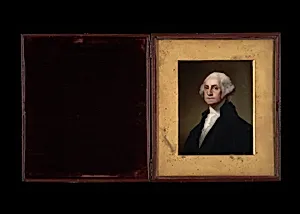
This miniature was painted after a bust-length portrait by Gilbert Stuart, in which Washington appears in a black jacket and white tie, his lips pursed in a serious expression. In 1845 the Charleston, South Carolina, Courier published this description of the miniature: “Benevolence, wisdom, and dignity are alike impressed on the venerable features; and so excellent is the likeness---so full, too of all the elements of goodness and greatness---that the beholder almost feels himself in the presenc...
Art Historical Context
This exquisite miniature portrait of George Washington painted around 1845 by Charleston artist Henry Brintnell Betheau, captures the first president's dignified likeness after Gilbert Stuart's renowned bust-length original. Rendered in the intimate scale typical of 19th-century miniaturesoften worn as personal treasures or displayed in homes—Washington appears in a black jacket white tie, his lips pursed in a serious, expression. Miniatures like this preserved cherished images for private devotion, blending technical precision with emotional resonance. A glowing 1845 review in the Charleston, South Carolina, Courier praised the work: “Benevolence, wisdom, and dignity are alike impressed on the venerable features; and so excellent is the likeness—so full, too, of all the elements of goodness and greatness—that the beholder almost feels himself in the presence of the departed excellence.” This reflects the profound reverence for Washington in antebellum America, where copies of Stuart's portraits symbolized national pride and moral virtue. Now in the Smithsonian American Art Museum, gifted by Mrs. Henry Du Pré Bounetheau and conserved through the Smithsonian Women’s Committee, this piece highlights the enduring cultural iconography of the "Father of His Country" in Southern artistry.