
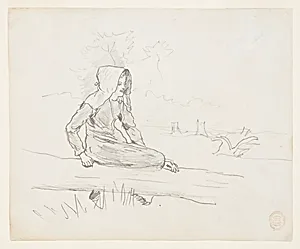
Girl Seated on a Tree Trunk
Classification
figures
Department
Smithsonian Collection
Museum
Smithsonian American Art Museum
Credit
Gift of Charles Savage Homer, Jr.
Accession Number
1912-12-66
Rights
Public Domain
About this artwork
Research in Progress
Art Historical Context
Winslow Homer, one of America's foremost Realist painters (1836–1910), captures a moment of quiet introspection in *Girl Seated a Tree Trunk* (1879). This work, classified as a figure, depicts a young girl perched naturally on a weathered tree trunk evoking the simplicity and vitality of rural American life., renowned for his masterful portrayals of everyday people against rugged natural backdrops, honed his skills through illustration before transitioning to fine art, often drawing from his observations in coastal Maine and the Adirondacks. Created in the late 1870s, during Homer's mature period, the painting reflects post-Civil War America's fascination with innocence and the outdoors. Homer's Realism emphasized truthful observation over idealization, using bold compositions and a keen sensitivity to light and texture—though the specific medium remains under research. His figures often symbolize resilience and harmony with nature, bridging the industrial age with pastoral ideals. A cherished piece in the Smithsonian American Art Museum, gifted by Homer's brother Charles Savage Homer, Jr., it invites visitors to ponder the girl's story amid the timeless embrace of the wild. Though details are still emerging, it exemplifies Homer's enduring legacy in celebrating ordinary beauty.