
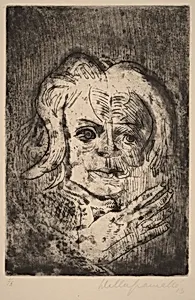
Girl with Hand
1923
Medium
etching on laid cream paper
Dimensions
plate: 30.7 × 20.8 cm (12 1/16 × 8 3/16 in.) sheet: 45 × 33.1 cm (17 11/16 × 13 1/16 in.)
Classification
Department
CG-W
Museum
National Gallery of Art, Washington, D.C.
Credit
Gift of Ruth Cole Kainen
Accession Number
2012.92.247
Rights
Public Domain
Art Historical Context
**Girl with Hand**, a delicate etching created by German Expressionist Walter Gramatté in 3, captures the artist's fascination with distorted forms and emotional intensity. Measuring 30.7 × 20.8 cm on its plate, this intimate print on laid cream paper invites close viewing, revealing the fine, etched lines that define a young girl's enigmatic figure, with her hand emerging as a focal point of quiet drama. Gramatté, who tragically died young at 32, was a master of Expressionism, blending Cubist fragmentation with Gothic spirituality in his works from the Weimar Republic era—a time of cultural ferment in post-World War I Germany. Etching, Gramatté's chosen medium here, exemplifies the technical precision of intaglio printmaking: lines incised into a metal plate with a needle, bitten by acid to create varying depths and tones, then inked and pressed onto paper. This process allowed artists like Gramatté to achieve rich, velvety textures and subtle gradations, making prints accessible yet highly expressive alternatives to paintings. The laid paper's subtle texture enhances the work's tactile quality, a nod to traditional craftsmanship amid modernist innovation. Today, **Girl with Hand** resides in the National Gallery of Art's print collection (Department CG-W), thanks to the generous gift of Ruth Cole Kainen. It stands as a testament to Gramatté's brief but brilliant career, offering visitors a window into the psychological depth of 1920s Expressionism.
About the Artist
Walter Gramatté · 1897–1929
Walter Gramatté, born Walter Eduard Gramatté on January 8, 1897, in Berlin-Wedding to building manager Otto Gramatté and his wife Katharina, emerged as a poignant voice in German Expressionism despite a tragically brief career. The son of modest parents—described variably as a baker in some accounts—Gramatté volunteered for World War I in 1914 but was largely spared frontline duty due to chronic p...