
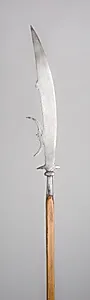
Glaive
c. 1600
Medium
Steel and wood
Dimensions
H.: 233.7 cm (92 in.); Blade with socket: H.: 87 cm (34 1/4 in.)
Classification
edged weapon-staff
Department
Applied Arts of Europe
Museum
Art Institute of Chicago
Accession Number
116276
Rights
Public Domain
Art Historical Context
This striking glaive from around 1600, attributed to the Italian School, is a powerful example of a European staff weapon. Standing 233.7 cm tall with a steel blade measuring 87 cm, it features a long wooden shaft fitted with a single-edged blade designed for both cutting and thrusting. Such polearms combined the reach of a spear with the slashing capability of a sword, making them versatile tools for infantry. By the early 17th century, firearms were changing European warfare, yet glaives remained in use on battlefields and in ceremonial roles. Italian metalworkers of the period were skilled in producing durable, well-balanced steel blades that reflected both practical needs and the era’s artistic standards. This piece, classified as an edged weapon-staff, illustrates the blend of function and craftsmanship typical of late Renaissance applied arts. Now in the Art Institute of Chicago’s Applied Arts of Europe collection, the glaive offers visitors a tangible connection to the military and cultural world of 1600s Italy, where weapons served as instruments of combat and markers of status.
About the Artist
Italian School · 1800–1899
The Italian School of the nineteenth century encompasses the diverse artistic output of painters, sculptors, and architects working across the Italian peninsula from 1800 to 1899, a period marked by profound political change including foreign occupations, the Risorgimento movement, and national unification in 1861. This era saw Italian art transition from Enlightenment ideals through Neoclassicism...