
Glass sprinkler flask
Unknown Artist
3rd–4th century CE
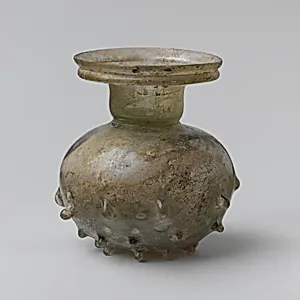
Medium
Glass
Dimensions
H. 3 1/8 in. (7.9 cm)
Classification
Glass
Culture & Period
Roman, Eastern Mediterranean · Late Imperial
Department
Greek and Roman Art
Museum
Metropolitan Museum of Art, New York, NY
Credit
Museum Accession
Accession Number
X.21.172
Rights
Public Domain
Art Historical Context
This delicate **Glass Sprinkler Flask**, dating to the 3rd–4th CE, hails from the Roman Eastern Mediterranean during the Late Imperial period. Standing just 3 1/8 inches (7.9 cm) tall, this small glass vessel exemplifies the everyday elegance of Roman craftsmanship. Produced in a region renowned for its glassmaking hubs like Syria and Egypt, it reflects the empire's sophisticated trade networks, where raw materials and techniques flowed freely across the Mediterranean. Crafted from blown glass—a revolutionary Roman innovation that allowed for thin, lightweight forms—the flask features a pierced top designed for sprinkling perfumes, oils, or ritual liquids. Its modest size made it portable for personal use, perhaps in grooming rituals or religious ceremonies, highlighting how glass transitioned from elite luxury to accessible beauty in late antiquity. The anonymous artisan's skill in shaping such a functional yet refined object underscores the period's artistic emphasis on utility and subtle decoration. On view in the Metropolitan Museum of Art's Greek and Roman Art department, this flask offers a tangible glimpse into the sensory world of ancient Romans, where even humble household items embodied cultural refinement and technological prowess.