
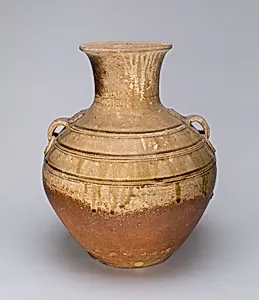
Globular Jar with Ring Handles
Western Han dynasty (206 B.C.–A.D. 9), 1st century B.C.
Medium
Stoneware with olive-green glaze and incised, impressed decoration and relief cordons
Dimensions
H.: 39.4 cm (15 1/2 in.)
Classification
stoneware
Department
Arts of Asia
Museum
Art Institute of Chicago
Accession Number
80896
Rights
Public Domain
Art Historical Context
This elegant Globular Jar with Ring Handles, standing at 15½ inches tall, hails from China's Western Han dynasty (206 B.C.–A.D. 9), specifically the 1st century B.C. Crafted during an era of imperial unity and technological innovation following the Warring States period, it exemplifies the Han's mastery of ceramics. The globular form with sturdy ring handles suggests practical use for storing grain, wine, or oils in households or tombs, reflecting everyday life and funerary customs of the time. Made of durable stoneware—a high-fired clay body more vitreous than earthenware—the jar features a distinctive olive-green glaze, an early achievement in Chinese ceramic glazing that produced a subtle, iridescent sheen. Artisans adorned it with incised lines (carved into the clay before firing), impressed motifs (stamped patterns), and relief cordons (raised, rope-like bands), adding texture and visual depth. These techniques highlight the Han potters' skill in combining functionality with decoration, bridging utility and artistry. On view in the Arts of Asia department at the Art Institute of Chicago, this jar offers a window into ancient China's ceramic evolution, paving the way for later masterpieces like celadon wares. Its anonymous creation underscores the collective ingenuity of Han workshops, inviting visitors to ponder the hands that shaped it over two millennia ago.
About the Artist
Unknown
The artist designated as "Unknown" in our virtual museum's collection exemplifies a poignant chapter in art history: creators whose identities have faded into obscurity despite the enduring power of their work. With only one known artwork attributed to them in our holdings, this figure represents countless anonymous hands that shaped visual culture across centuries. Museums worldwide, including th...