
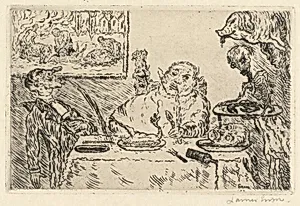
Gluttony (La gourmandise)
1904
Medium
etching
Classification
Portfolio
Department
CG-E
Museum
National Gallery of Art, Washington, D.C.
Credit
Rosenwald Collection
Accession Number
1964.8.2758
Rights
Public Domain
Art Historical Context
James Ensor’s 1904 etching “Gluttony (La gourmandise)” captures the Belgian artist’s lifelong fascination with human vice and social satire. A leading figure in the Symbolist and early Expressionist movements, Ensor frequently turned to the seven deadly sins as vehicles for sharp commentary on bourgeois excess. Here, the theme of overindulgence is rendered with the grotesque humor and masked figures that became his signature, inviting viewers to confront their own appetites through a fantastical lens. As an etching, the work showcases the medium’s capacity for fine, biting lines and rich tonal contrasts. Ensor exploited these qualities to create crowded, dreamlike scenes where everyday objects and distorted bodies merge, heightening the print’s satirical edge. Produced during a period when he was already celebrated for his graphic work, this piece belongs to a portfolio that allowed his biting visions to reach wider audiences through multiple impressions. Housed in the National Gallery of Art’s Rosenwald Collection, the etching remains a vivid example of how Ensor transformed traditional moral subjects into modern, psychologically charged images that continue to resonate with contemporary viewers.
About the Artist
James Ensor · 1860–1949
James Ensor (1860–1949) was a Belgian painter and printmaker whose visionary, often grotesque imagery anticipated Expressionism, Surrealism, and much of the avant-garde art of the twentieth century. Born in Ostend to an English father and Flemish mother who ran a curio shop selling seashells, masks, and carnival souvenirs — objects that would pervade his art — Ensor studied at the Brussels Academy...