
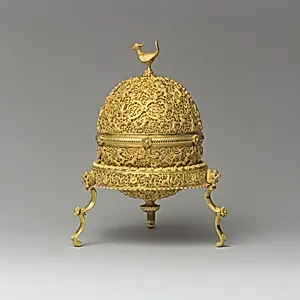
Goa Stone and Gold Case
Unknown Artist
late 17th–early 18th century
Medium
Container: gold; pierced, repoussé, with cast legs and finials Goa stone: compound of organic and inorganic materials
Dimensions
Goa stone: Diam. 1 3/16 in. (3 cm) Container: H. 2 5/8 in. (6.7 cm) Diam. 5 11/16 in. (14.4 cm)
Classification
Metal
Department
Islamic Art
Museum
Metropolitan Museum of Art, New York, NY
Credit
Rogers Fund, 2004
Accession Number
2004.244a–d
Rights
Public Domain
Tags
Art Historical Context
This exquisite *Goa Stone and Gold* from the late th to early 18th century exemplifies the opulent metalwork of Islamic art in Goa, Portuguese India. Crafted by an unknown artist the container is made of gold, featuring intricate pierced work and repoussé decoration—techniques where the metal is hammered from the reverse to create raised motifs. Cast legs and finials elevate its form, while the surface bursts with lively imagery: griffins, peacocks, dogs, monkeys, blooming flowers, blending mythical creatures with natural motifs in a harmonious, fantastical tableau. At its heart lies the Goa stone, a rare compound of organic and inorganic materials (diameter 1 3/16 in.), revered as a universal remedy and talisman in Mughal and Islamic traditions. These portable "bezoars" were believed to cure ailments, neutralize poisons, and ward off evil, making them prized possessions traded across Asia and Europe. Housed in the Metropolitan Museum of Art's Islamic Art Department (acquired via Rogers Fund, 2004), this piece (container: H. 2 5/8 in., Diam. 5 11/16 in.) highlights the cultural fusion of Indian craftsmanship, Persian influences, and Portuguese colonial exchange, turning medicine into magnificent art.