
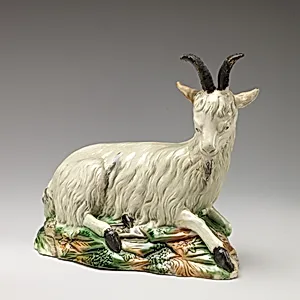
Goat
ca. 1770–80
Medium
Lead-glazed earthenware
Dimensions
Height: 6 5/8 in. (16.8 cm)
Classification
Ceramics-Pottery
Culture
British, Burslem, Staffordshire
Department
European Sculpture and Decorative Arts
Museum
Metropolitan Museum of Art, New York, NY
Credit
Gift of R. Thornton Wilson, 1942
Accession Number
42.52.3
Rights
Public Domain
Tags
Art Historical Context
This charming lead-glazed earthenware figure of a goat was created around 1770–1780 by Ralph Wood the Younger in Burslem, Staffordshire, a thriving center of British pottery production. Standing just over six inches tall, the piece reflects the Wood family’s expertise in modeling small-scale animal and figure groups that captured the lively spirit of rural life. The glossy lead glaze, typical of Staffordshire wares, gives the sculpture a warm, colorful sheen that would have brightened any Georgian household. Staffordshire potters like the Woods catered to a growing middle-class market eager for affordable decorative objects. These hand-finished figures often served as mantelpiece ornaments or conversation pieces, blending folk-art traditions with the refined tastes of the period. The simple yet expressive modeling of the goat demonstrates the technical skill required to balance natural observation with the playful charm expected of such pieces. Today, this work in the Metropolitan Museum’s collection offers a delightful glimpse into eighteenth-century British ceramic art, illustrating how everyday subjects could be transformed into enduring decorative treasures.
About the Artist
Ralph Wood the Younger · 1748–1795
Ralph Wood the Younger was born in Burslem, Staffordshire, in 1748, the son of the celebrated potter Ralph Wood the Elder and a member of a family that stood at the center of the Staffordshire ceramics industry during its most creative and internationally influential period. Growing up in the workshops of his father, he absorbed from childhood the technical traditions of English earthenware produc...