
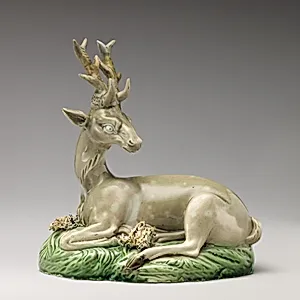
Stag (one of a pair)
18th century
Medium
Lead-glazed earthenware
Dimensions
6 1/2 × 6 1/4 in. (16.5 × 15.9 cm)
Classification
Ceramics-Pottery
Culture
British, Burslem, Staffordshire
Department
European Sculpture and Decorative Arts
Museum
Metropolitan Museum of Art, New York, NY
Credit
From the Marion E. and Leonard A. Cohn Collection, Bequest of Marion E. Cohn, 1966
Accession Number
66.64.24
Rights
Public Domain
Tags
Art Historical Context
This charming lead-glazed earthenware figure of a *Stag (one of a pair)*, crafted by Ralph Wood the Younger in 18th-century Britain, exemplifies the lively pottery tradition of Burslem, Staffordshire. Standing just 6 1/2 × 6 1/4 inches, this petite sculpture captures the majestic form of a deer with molded details and a glossy lead glaze that adds vibrancy and durability. Produced during the height of the Industrial Revolution, when Staffordshire potteries like the Woods' family enterprise revolutionized affordable decorative arts, it was designed for middle-class homes—perfect for mantelpieces or shelves. Ralph Wood the Younger (c. 1748–1795), son of a pioneering potter, specialized in colorful, figurative ceramics that brought whimsy and nature into everyday spaces. His workshop's lead-glazed earthenware technique involved press-molding clay into lively animal forms, then firing with a tin-based glaze for a shiny, jewel-like finish resistant to wear. These stags, part of a matching pair, reflect the era's fascination with hunting motifs and pastoral themes, symbolizing nobility and the British countryside. Today, housed in The Metropolitan Museum of Art's European Sculpture and Decorative Arts Department from the Marion E. and Leonard A. Cohn Collection, this piece highlights Staffordshire's global influence on ceramics, blending artistry with mass production for enduring appeal.
About the Artist
Ralph Wood the Younger · 1748–1795
Ralph Wood the Younger was born in Burslem, Staffordshire, in 1748, the son of the celebrated potter Ralph Wood the Elder and a member of a family that stood at the center of the Staffordshire ceramics industry during its most creative and internationally influential period. Growing up in the workshops of his father, he absorbed from childhood the technical traditions of English earthenware produc...