
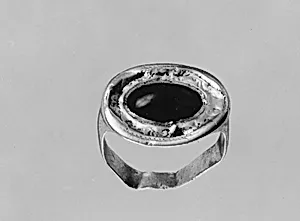
Gold ring with a garnet
Unknown Artist
300–250 BCE
Medium
Gold, garnet, finger bone
Dimensions
H. of bezel 13/16 in. (2 cm) width of bezel 5/8 in. (1.6 cm) H. of hoop 13/16 in. (2 cm)
Classification
Gold and Silver
Culture & Period
Greek · Hellenistic
Department
Greek and Roman Art
Museum
Metropolitan Museum of Art, New York, NY
Credit
Gift of David L. Davis, 1961
Accession Number
61.89a, b
Rights
Public Domain
Art Historical Context
This exquisite gold ring with a garnet, crafted around 300–250 BCE during the Hellenistic period, exemplifies the opulent jewelry of ancient Greece. Originating from a time when Alexander the Great's conquests fused Greek artistry with Eastern influences, the ring features a bezel set with a vibrant garnet gemstone, measuring just 13/16 inch (2 cm) high and 5/8 inch (1.6 cm) wide. Its hoop, also 13/16 inch (2 cm) high, showcases the fine goldsmithing techniques of the era, where artisans hammered and soldered thin gold sheets into intricate forms. The inclusion of a finger bone in the medium adds a layer of mystery and intimacy, possibly hinting at personal or memorial significance in Hellenistic culture, where jewelry often served as talismans or status symbols. Garnets, prized for their deep red hue symbolizing vitality, were cut and polished to catch the light, demonstrating advanced lapidary skills. As a gift to the Metropolitan Museum of Art in 1961 from David L. Davis, this piece from the Greek and Roman Art department invites us to ponder the daily lives of the elite, blending beauty with profound human connection.