
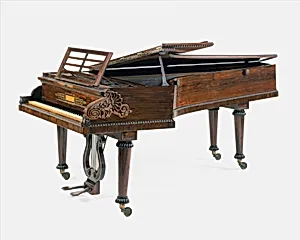
Grand Piano
Medium
Rosewood veneer, oak, metal, ivory, ebony, maple, beech, brass, leather
Dimensions
Height: 36 7/16 in. (92.5 cm) Width (parallel to keyboard): 49 3/4 in. (126.4 cm) Depth (perpendicular to keyboard): 97 15/16 in. (248.7 cm)
Classification
Chordophone-Zither-struck-piano
Culture
British
Department
Musical Instruments
Museum
Metropolitan Museum of Art, New York, NY
Credit
Gift of Professor Stoddard Lincoln, 1972
Accession Number
1972.109
Rights
Public Domain
Art Historical Context
Step into the refined world of 19th-century British music with this stunning 1827 grand piano crafted by John Broadwood &, renowned London piano makers. Measuring nearly eight feet in depth, this elegant instrument exemplifies the golden age of piano design, when grand pianos evolved from drawing-room novelties into powerful concert hall staples. Its rosewood veneer over oak provides a luxurious sheen, while intricate details in ivory keys, ebony accents, maple, beech, brass, metal, and leather highlight the exquisite woodworking and metalworking techniques of the era. Broadwood & Sons were pioneers in piano innovation, perfecting the English grand action that allowed for greater dynamic range and expressiveness—essential for the Romantic composers like Beethoven and Chopin who dazzled audiences across Europe. Classified as a chordophone-zither-struck piano, it features hammers striking strings under a zither-like soundboard, producing the rich, resonant tone that defined classical music. Donated to the Metropolitan Museum of Art in 1972 by Professor Stoddard Lincoln, this piece transports visitors to Regency-era salons, where music intertwined with social prestige and artistic ambition. Today, it stands as a testament to Britain's industrial artistry, blending functionality with opulent craftsmanship in the Musical Instruments department.