
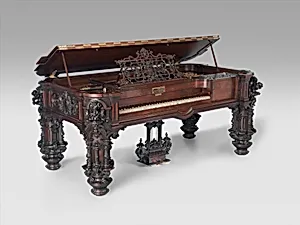
Square Piano
Medium
Rosewood, mother-of-pearl, tortoiseshell, abalone, felt, metal, paint, gilding
Dimensions
Height: 37 3/4 in. (95.9 cm) Width: 87 15/16 in. (223.3 cm) Depth: 46 7/16 in. (118 cm)
Classification
Chordophone-Zither-struck-piano
Culture
American
Department
Musical Instruments
Museum
Metropolitan Museum of Art, New York, NY
Credit
Gift of George Lowther, 1906
Accession Number
06.1312
Rights
Public Domain
Art Historical Context
Step into the elegant world of 19th-century American parlors with this stunning *Square Piano* crafted in 1853 by renowned New York makers Robert Nunns and John. Measuring an impressive 87 inches wide, this rosewood beauty exemplifies the square piano's dominance in middle- and upper-class homes before upright models took over. Its lavish decoration—featuring intricate inlays of mother-ofpearl, tortoises, and abalone, accented by paint, gilding, and metal fittings—transforms it from mere instrument to a work of furniture art, symbolizing wealth and refinement. As a chordophone-zither-struck piano, it produces its signature warm tone through felt-covered hammers striking strings, a design refined in America during the piano boom of the antebellum era. Nunns & Clark were pioneers in this craft, blending European traditions with innovative American manufacturing to create durable, resonant instruments prized by musicians and hostesses alike. The use of exotic materials like abalone shell highlights the era's global trade influences and skilled cabinetry techniques. Generously gifted to the Metropolitan Museum of Art in 1906 by George Lowther, this piano offers a tangible link to the social music-making that defined Victorian America, inviting us to imagine Chopin waltzes echoing through candlelit rooms.
About the Artist
Robert Nunns|John Clark (British|British) · 1791 |1833 –1869 |1858
British, (active United States) 1791–1869|British (active United States), active 1833–1907