
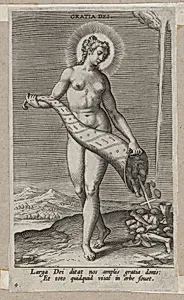
Gratia Dei, from "Proposopographia"
ca. 1585–90
Medium
Engraving
Dimensions
plate: 6 1/16 x 3 9/16 in. (15.4 x 9.1 cm)
Classification
Prints
Department
Drawings and Prints
Museum
Metropolitan Museum of Art, New York, NY
Credit
Harris Brisbane Dick Fund, 1953
Accession Number
53.601.14(82)
Rights
Public Domain
Tags
Art Historical Context
**Gratia Dei, fromProposopographia*** *Philips Galle, ca. 1585–90* Engraving; plate: 6 1/16 x 3 9/16 in. (15.4 x 9.1 cm) The Metropolitan Museum of Art, Brisbane Dick Fund, 3 Step into the intricate world of late 16th-century Flemish engraving with Philips Galle's *Gratia Dei* ("Grace of God"), part of the series *Proopographia*. Created around 1585–90 in Antwerp, this small yet masterful print exemplifies the Northern Renaissance's emphasis on allegory and moral symbolism. Galle, a prolific engraver associated with the renowned Plantin-Moretus printing house, specialized in translating elaborate designs into precise, reproducible images that spread humanist and religious ideas across Europe. The engraving likely depicts a graceful female nude embodying divine grace, accompanied by a cornucopia symbolizing abundance and providence. This combination evokes Christian virtues, blending classical motifs with Reformation-era piety. Engraving's fine lines allowed Galle to achieve remarkable detail in such a compact format (just over 6 by 3.5 inches), making it ideal for collectors' albums or devotional study. As a print medium, it democratized art, enabling widespread dissemination of sophisticated iconography. Housed in the Met's Drawings and Prints department, *Gratia Dei* highlights Galle's technical virtuosity and the cultural fusion of sensuality and spirituality in Renaissance prints. A delightful window into how everyday viewers once pondered divine favor through beauty and bounty!
About the Artist
Philips Galle · 1537–1612
Philips Galle (1537–1612) was a leading Netherlandish engraver, designer, and print publisher whose career bridged the vibrant artistic scenes of Haarlem and Antwerp. Born in Haarlem, he studied under the humanist engraver Dirck Volkertsz. Coornhert, honing his skills in reproductive printmaking. Early on, Galle produced engravings after the Haarlem master Maarten van Heemskerck, capturing the Man...