
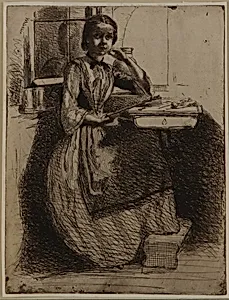
Gretchen at Heidelberg
Classification
Department
Smithsonian Collection
Museum
Smithsonian American Art Museum
Credit
Gift of Charles Lang Freer
Accession Number
F1898.226
Rights
Public Domain
Tags
About this artwork
Whistler etchings are identified by "G" numbers as assigned in "James McNeill Whistler: The Etchings, a catalogue raisonne," by Margaret F. McDonald, Grischka Petri, Meg Hausberg, and Joanna Meacock (University of Glasgow, 2012), http://etchings.arts.gla.ac.uk. This print is G21 state 1 of 1.
Art Historical Context
In 1858, James McNeill Whistler, renowned American artist famous for his elegant, atmospheric works and association with the Aesthetic movement, *Gretchen at Heidelberg This intimate portrait etching (catalogued as G21, 1 of 1 in the definitive University of Glasgow catalogue raisonné) captures a moment from Whistler's early travels in Europe, likely evoking the German city of Heidelberg and perhaps alluding to the literary figure Gretchen from Goethe's *Fa*. Produced during his formative etching phase (1857–1861), it reflects his fascination with Realism and the technical precision of 19th-century printmaking, influenced by masters like Rembrandt. Whistler's etchings revolutionized the medium, emphasizing subtle tones, fine lines, and a painterly quality achieved through biting acid into metal plates. As a print, *Gretchen at Heidelberg* exemplifies his innovative approach, blending portraiture with evocative storytelling. Though the specific medium details are unknown, its classification as an etching highlights the process's intimacy—ideal for capturing personality and place with remarkable detail. Today, this rare work graces the Smithsonian American Art Museum, part of the esteemed Charles Lang Freer collection, gifted to celebrate American artistic excellence. Visitors will appreciate how it showcases Whistler's precocious talent abroad, bridging U.S. and European traditions in a single, haunting image.