
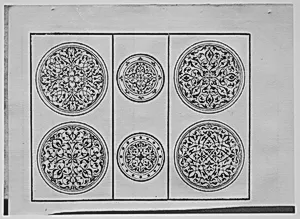
Grotesken und Mauresken
Medium
Woodcut
Dimensions
22 x 16 x 3 in. (55.9 x 40.6 x 7.6 cm)
Classification
Books|Prints|Ornament & Architecture
Department
Drawings and Prints
Museum
Metropolitan Museum of Art, New York, NY
Credit
Harris Brisbane Dick Fund, 1925
Accession Number
25.49
Rights
Public Domain
Tags
About this artwork
"Grotesken und Mauresken" by Peter Flötner|Hans Rudolf Manuel Deutsch the Younger|Rudolph Wyssenbach, created in 1549, is executed in woodcut. This books|prints|ornament & architecture belongs to the Metropolitan Museum's Drawings and Prints collection. The work measures 22 x 16 x 3 in. (55.9 x 40.6 x 7.6 cm). The artwork entered the museum's collection through harris brisbane dick fund, 1925.
Art Historical Context
**Grotesken und Maken** (1549) is a captivating woodcut print book by a trio of Northern Renaissance masters Peter Flötner, Nuremberg sculptor and designer renowned for his intricate ornamental motifs; Hans Rudolf Manuel Deutsch Younger, a Swiss engr with a flair for detailed line work; and Rudolph Wyssen, their collaborator. Measuring 22 x 16 x 3 inches, this work belongs to the Metropolitan Museum Art's Drawings and Prints, acquired through the Harris Brisbane Dick Fund 1925. As a prime example of 16th-century ornament and architecture prints, it showcases the era's fascination with fantastical patterns. The title refers to *grotesken*—whimsical, hybrid motifs inspired by ancient Roman decorations rediscovered during the Renaissance—and *mauresken*, exotic arabesque designs evoking Moorish artistry. Woodcut, a relief printing technique carved into wood blocks, was ideal for reproducing these intricate, repeating patterns at scale, making them accessible to artists, architects, and craftsmen across Europe. Such pattern books fueled the decorative arts boom, influencing everything from book illustrations to architectural friezes. This collaborative gem highlights the interdisciplinary spirit of the time, blending German precision with Swiss finesse. Visitors will appreciate how it captures the playful yet sophisticated revival of classical and "exotic" forms, bridging art and design in the 1540s cultural landscape. (198 words)
About the Artist
Peter Flötner|Hans Rudolf Manuel Deutsch the Younger|Rudolph Wyssenbach · 1485–1546
Peter Flötner (c. 1485–1546) was a German sculptor, ornament designer, and medalist whose work played a central role in the transmission of Italian Renaissance decorative vocabulary into the German-speaking lands. Though his exact origins remain uncertain — he may have trained in Augsburg before settling permanently in Nuremberg around 1522 — his formation evidently included exposure to Italian Re...