
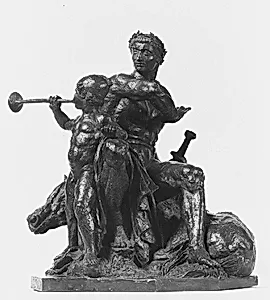
Group Symbolic of War
19th century
Medium
Bronze, brown patina
Dimensions
Height: 20 7/8 in. (53 cm)
Classification
Sculpture-Bronze
Culture
French
Department
European Sculpture and Decorative Arts
Museum
Metropolitan Museum of Art, New York, NY
Credit
Samuel D. Lee Fund, 1940
Accession Number
40.23.1
Rights
Public Domain
Tags
Art Historical Context
Antoine-Louis Barye, a leading French sculptor of the 19th century, crafted *Group Symbolic of War* as a dynamic bronze ensemble, exemplifying his pioneering animalier style. Known for his anatomically precise depictions of animals infused with raw energy, Barye drew inspiration from Romanticism's fascination with nature's ferocity and human drama. Cast in bronze with a rich brown patina that enhances its dramatic depth, this 20⅞-inch-high sculpture captures a chaotic tableau of men, boys, animals, and musical instruments—likely evoking the clamor of battle through trumpets or drums. The work's historical significance lies in Barye's innovative fusion of allegory and realism during France's turbulent post-Napoleonic era. Symbolizing war's primal fury, the grouped figures twist in vigorous motion, showcasing his mastery of lost-wax casting techniques that allowed intricate details in fur, muscle, and fabric. This piece reflects the era's shift toward naturalistic sculpture, moving beyond classical idealism. Acquired through the Samuel D. Lee Fund in 1940, *Group Symbolic of War* resides in the Metropolitan Museum of Art's European Sculpture and Decorative Arts collection. It invites visitors to ponder war's timeless chaos, blending human ambition with animal instinct in a compact yet powerful form.
About the Artist
Antoine-Louis Barye · 1795–1875
Antoine-Louis Barye (1795–1875) was born in Paris on September 24, the son of goldsmith Pierre Barye and Marguerite Barye. Following family tradition, he apprenticed as a goldsmith under his father and, around 1810, with Martin-Guillaume Biennais, goldsmith to Napoleon. After brief military service, Barye pursued sculpture, studying under François-Joseph Bosio in 1816 and painter Baron Antoine-Jea...