
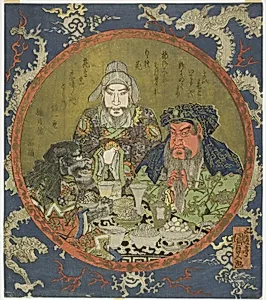
Guan Yu, Liu Bei, and Zhang Fei
Medium
Color woodblock print; shikishiban, surimono
Dimensions
22.4 × 19.8 cm (8 7/8 × 7 13/16 in.)
Classification
woodblock print
Department
Arts of Asia
Museum
Art Institute of Chicago
Accession Number
81296
Rights
Public Domain
Art Historical Context
This vibrant color woodblock print by Utagawa Kunisada I (also known as Toyokuni III) captures three legendary figures from Chinese history and literature: the warrior Guan Yu, the future emperor Liu Bei, and the fierce Zhang Fei. Created in 1825 during Japan’s Edo period, the work draws from the classic novel *Romance of the Three Kingdoms*, portraying the sworn brothers whose loyalty and bravery captivated audiences across East Asia. Kunisada, one of the most prolific ukiyo-e artists of his time, specialized in dynamic compositions and expressive figures, often blending theatrical energy with historical subjects. The print’s shikishiban format—a compact square—and surimono technique mark it as a refined, privately commissioned piece. Surimono were typically produced in limited editions with luxurious details such as embossing, metallic pigments, and space for poetry, distinguishing them from more commercial prints. Here, the medium highlights Kunisada’s mastery of color layering and crisp line work, allowing the figures’ costumes and expressions to stand out vividly within the intimate 22.4 × 19.8 cm dimensions. As part of the Art Institute of Chicago’s Arts of Asia collection, the print reflects the deep cultural exchange between Japan and China during the nineteenth century. It offers viewers a glimpse into how Japanese artists reinterpreted foreign legends through the refined lens of ukiyo-e, celebrating themes of brotherhood and valor that resonated with Edo-period audiences.
About the Artist
Utagawa Kunisada I (Toyokuni III) · 1786–1864
Utagawa Kunisada I, also known as Toyokuni III (1786–1865), was born Sumida Shōgorō in the Honjo district of Edo (modern Tokyo) into a family that operated a hereditary ferry-boat service, providing stability after his father's early death. Displaying prodigious talent in drawing from childhood, he became an apprentice to the master Utagawa Toyokuni I around 1801 at age fifteen, entering the prest...